This blog is part of a site named landinportugal.org where you can find the stories of more than one hundred planes that during WWII landed or crashed in Portugal. Here I will announce the updates and also publish stories and information related with WWII in Portugal. All the stories will be in English and there another twin blog in Portuguese... forgive if sometimes the English is not always correct...


Showing posts with label Book. Show all posts

Wednesday, May 16, 2012

A few questions to Ronald Weber

Ronald Weber is professor emeritus of American studies at the University of Notre Dame, Indiana, United States.

He has published romances and non-fiction. 

His past books include News of Paris, America in Change, The Literature of Fact, and Hired Pens.

His most recent work "The Lisbon Route - Entry and Escape in Nazi Europe" was originally published in March 2011. 

In last April a Portuguese version appeared in the bookshops.
There can find the story of Lisbon as the entry and escape hatch for a Europe deeply involved in WWII.


There is still a discussion about how many refugees arrived in Portugal.

Certain is that thousands found in the Lisbon harbor the chance to escape the Nazi advance. 

Rich people, poor people, intellectuals or just common people arrived in cars, by train, in bicycles and even on foot.   


Land in Portugal – How did you become interested in the story of the refugees, escapees and others that went through Portugal to leave or enter Europe?

Ronald Weber - I was a visiting lecturer in American culture at the University of Coimbra in 1968-69.  

It was then that I first heard stories about German pilots coming to neutral Portugal during the war for rest and recreation.  

But it wasn't until I published in 2006 a book called NEWS OF PARIS: AMERICAN JOURNALISTS IN THE CITY OF LIGHT BETWEEN THE WARS that I recalled those earlier stories when I learned that many journalists and others escaped Europe through Lisbon after the fall of France in 1940.  

I decided then that my next book would be about Lisbon as the great escape hatch of WWII.

LP – Although occupying the same physical space you describe two different countries that rarely touched each other. One for the Portuguese and another for all the others. How was this possible?

RW - The refugees and others who reached Portugal were required by the Salazar government to move on as quickly as possible to countries that would accept them for permanent resettlement.  

As a result, the new arrivals made few contacts with Portuguese citizens beyond workers in hotels and restaurants, agents of shipping companies and commercial airlines, and local police officers.  

Beyond that, the refugees were gathered together in Lisbon and a few others towns, such as Caldas da Rainha and Ericeira, were authorities required them to stay while awaiting resettlement.  Portuguese elsewhere in the country would have had little or no awareness of the many thousands of people flowing through the country.  

But one caution here.  I studied those coming and going through Portugal during the war from their point of view.  

It was their story I tried to tell.  Another story is what the Portuguese may have thought and felt about such new arrivals.  

To get at that story one would have to look into purely Portuguese material in the form of letters, diaries, memoirs, novels, etc.


LP – Reaching Portugal was not – for most of these refugees - the end of the line or the end of the fear?

RW -  Reaching Portugal was the end of the line for very few people (Calouste Gulbenkian was among the few) since Portugal wouldn't allow the creation of a permanent colony of refugees.  

Many had an overwhelming sense of freedom when they reached the country.  But there was always a sense that Germany could end Portugal's neutrality whenever it wished.  There were as well always stories of the Nazis abducting from the streets of Lisbon figures they wanted, especially anti-Nazi Jews.

It was always understood by the new arrivals that full freedom required leaving Lisbon behind.


The Lisbon Route, from Ronald Weber was published in 2011. You can find more about it  HERE.


LP – You have a chapter dedicated to the lights of Lisbon. Was it really something that fascinated the refugees?

RW - Lisbon's brilliant illumination at night dazzled the new arrivals coming from largely blacked-out Europe.  

It hardly seemed possible that tiny Portugal could live as if the war did not exist.

Equally dazzling, especially early in the war, was the abundance of food in Portugal after the shortages and rationing refugees had experienced in Europe.


LP – Was there any story more surprising for you than any of the others?

RW - I knew that wartime Lisbon was a center of spy activity, but I didn't know the tangled extent of it--including the great number of Portuguese employed as low level watchers and tipsters.  

I think a full account of Lisbon as a spy center is yet to be written.  Another area that surprised me was that of relief groups (Quakers, Unitarians, Jewish groups, etc.) who moved their center of operations to Lisbon during the war and made heroic efforts to aid the refugees with funding, housing, and counseling.

Carlos Guerreiro

Friday, October 8, 2010

Still in the Azores route


After the publication of the earlier articles there were some feedbacks, especially in the “twin” Portuguese Blog, that I must forward, in order to complete the story of the Azores. I know there will be always new material coming but I believe this gives a wide image of what has happened.

I will let out the material only in Portuguese, although, if someone is interested please go to the Portuguese Forum in www.aterrememportugal.blogspot.com or e-mail me. I will send the information over.

Anyway there is a Portuguese item in this post, because I believe it has great “visual” information. A couple of days ago a video was posted. It was in English and had some great pictures. I found another video with even more material. There are some pictures from the earlier British Pathé movie, but it is mush more complete.

Pass the first three minutes and you will start to see “Fortresses”, Hudsons’s, and even a Wellington in a camera movement that shows a couple of planes stationed in the airfield. There are also pictures with Portuguese people helping in building the infrastructure and so on. The images include also the arrival of the Americans and the first Hangar’s and other buildings.

At the end you can see a party offered by the local’s to the British newcomers, with a bullfight and so on. Hope you like it….


Gonçalo Mendes in the Portuguese Blog suggests also the following book and link. Both have the American point of view.


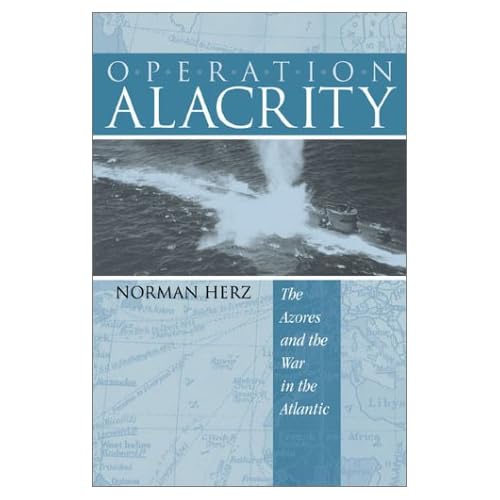
The book is “OPERATION ALACRITY - The Azores and the War in the Atlantic” from Norman Herz. He arrived in the island as a corporal with the U.S. Army Corps of Engineers' 928th Engineer Aviation Regiment, and latter wrote this book about the events and the importance of the island for the war effort.

There is also a site dedicated to the 801st Engineer Aviation Battalion in Word War II, that arrived in January 1944 in the Azores. It was made by the son of Robert Hawks, one of the soldiers that was part this battalion.

This is the Link: http://www.skydozer.com/index.html

 Besides that I would also leave the official site of the base in our days…

http://www.lajes.af.mil/index.asp

Best regards to all...

Thursday, September 30, 2010

A few questions to Robert M. Stitt

By Carlos Guerreiro

Robert Stitt recently published his first book, that has already been presented in this Blog. “Land in Portugal” was able to send some questions to the author that present’s the story of the Fortress on service of the Coastal Command, but also the story and their mission in the Portuguese islands of the Azores.

The Agreement to concede facilities in the Azores – Terceira Island, in the Lagens Airfield – was signed in August 1943 between the Portuguese and British Government. With this treaty Portugal conceded benefits to one of the belligerents, continuing although as a neutral country until the end of the conflict. The Fortresses were in the first groups that arrived there.

Part of what happened there in first years after the agreement can be found in this book.

Land in Portugal: Why a book about the Fortress in Coastal Command?
Robert Stitt: I had previously written the history of a USAAF Boeing B-17E Fortress that had crash-landed in Papua New Guinea in January 1943 - I visited the site in 1977. This aircraft was originally supposed to go the Britain for the campaign against the U-boats and documenting the type's history with RAF Coastal Command was a natural follow-on project.

LP: How long and where did you researched to complete the book?
RS: The Fortress with Coastal Command project took six years to complete. I visited The National Archives in the United Kingdom twice to get started. At the same time my network of 'helpers' grew and grew and I was very fortunate to make contact with many generous fellow researchers around the world, veterans who served on the Fortress and their families.


Fortress IIA FL459 - involved in the sinking of U707 in 9 November 1943. This is one of the 14 colour profiles by Juanita Franzi that you can find in the book

LP: What was the impression of the crew’s about the plane?
RS: They all seemed to love and trust the Fortress. It was stable, reliable and comfortable (well, relatively) and I got the impression that, although the Liberator had greater range and load carrying capability, crews preferred the Fortress.

LP: From your point of view how important were the Azores in the final period of the war?
RS: They were very important for two reasons. Firstly, Allied shipping losses across the central Atlantic were unsustainable until the Azores base became operational. And Lagens quickly became a vital staging point for aircraft being delivered to the United Kingdom, Middle East, and Far East.


One page from the book where you can see two pictures taken in the Lagens Airfield. In the first you can see how the modern and the old lived together. On the other you can see the base from above and understand the poor conditions in which the men lived.


LP: How did the crews looked to the Azores and to the Portuguese people?
RS: I believe they were very proud of the role they played in the war and got on well with the Portuguese people, except perhaps when they were being shot at by over-zealous Portuguese anti-aircraft gunners who had recently been equipped with British guns as part of the deal to use the islands! I know too that one Fortress captain married the governor's daughter!

LP: What were the biggest difficulties they found in the island?
RS: There was only tented accommodation when the airmen arrived so they virtually lived outside for several months. Water was often in very short supply and there was a population very large rats. The steel plank runway was covered with red volcanic soil and conditions were both extremely dusty at times and very noisy when aircraft landed and took off, day and night. The dust also contributed to a deadly outbreak of polio. Strong winds were often not in alignment with the single runway and visibility could be very bad, forcing pilots to chose between a blind approach between two ridges or diverting to Santa Ana (in S. Miguel Island) with its soft runway and often similarly bad weather. On the positive side, there were plenty of fruit, vegetables, cigarettes and alcoholic beverages, a town to visit with no blackout, and no enemy aircraft.

LP: Can you describe the situation that most impressed you while you were researching for the book?
RS: The help received from other researchers and the trust of the families of veterans who lent me their precious documents, photographs and mementos.

LP: What would you like to say to your reader?
RS: The young men of RAF Coastal Command who flew Fortresses and other aircraft - crew members were often under 21 - did extraordinary things to ensure the survival of Britain and its Allies. They need to be remembered and I hope my book goes some way to helping this happen.


To know more about this book please click here

Sunday, September 26, 2010

The B-17 in the Azores

A new book was released this summer about the B-17 in service of the RAF Coastal Command, named “Boeing B-17 Fortress in RAF Coastal Command Service”.

The British baptized the aircraft “Fortress” and it initially equipped Coastal Command, because the earlier Fortress I (B-17C) had performed poorly during operations with 90 Squadron, later models were not available in sufficient numbers, and the type was unsuitable for the night time bombing role.


The Bomber Command used as heavy bombers the Lancaster, the Halifax and the Stirling. The Fortress and the Liberator (B-24), both of American construction, were used by this Command for secondary missions (electronic counter-measures, patrol, transport and others).

Initial deliveries, sent by the Americans, would be allocated to the Coastal Command. A bonus that this command cherished, as most their aircraft – especially in the first part of the conflict – were the leftovers from the other commands of the RAF (Fighter and Bomber).

It is not for any reason the Coastal Command become known as the “Cinderella Service”.

This book has the particularity of following the activities from the B-17 in the Coastal Command and to dedicate one fifth of its pages (43 in 248) to their presence at the Lagens base, in the Azores.

All the aircraft involved are listed, the work of their crews described, including some epic encounters with enemy submarines. It is fully illustrated with many wartime photos, and scale plans of the airframe modifications. There are also full colour profiles of representative aircraft.

Here is the index of the book related with the Azores.

The Azores......................79
Obvious Choice..................82
Operation Alacrity .............85
Building a Base.................88
Day-and-Night Team..............89
Life at Lagens………...............94
Typical Mission.................95
Precious Petrol……..............102
Attacking a U-boat ............105
Desired Effect…................107
Transit Point….................108
The Americans Arrive...........111
Action and Departure...........112
Maintaining the Guard..........116
Engine Failures…...............118
Withdrawal……...................119

To purchase the book you can link here:
http://www.mmpbooks.biz/mmp/books.php?book_id=123

Best regards
Carlos Guerreiro

(This post has suffered changes related to historical aspects,in 28 September 2010, after the contact from the author of the book wish I thank)