This blog is part of a site named landinportugal.org where you can find the stories of more than one hundred planes that during WWII landed or crashed in Portugal. Here I will announce the updates and also publish stories and information related with WWII in Portugal. All the stories will be in English and there another twin blog in Portuguese... forgive if sometimes the English is not always correct...


Saturday, February 19, 2011

A few questions to Robert Wilson

By Carlos Guerreiro
(Pictures from Robert Wilson oficial site)


Robert Wilson is a British author living in Portugal for many years. At this moment he lives in Redondo, a small village in Alentejo, and it is there that his latest books have been written. From the ten he already published two are related with Portugal: “A SMALL DEATH IN LISBON” (1999) and “THE COMPANY OF STRANGERS” (2001). Both of them center one important part of their action in the Portuguese WWII era, and that is the reason for a couple of questions to the author.

In the center of this conversation is specially the first book that focus on the badly known “wolfram war”, that only in the last years has been better revealed even in Portugal. Also this is one of the most important books from Wilson as he received the “1999 CWA Gold Dagger” award the “2003 International Deutsche Krimi Prize”.

Land in Portugal: Part of the action of the books you wrote about Portugal is taking place in the WWII period. Why have you choose that era and subject?

Robert Wilson: I had written four books set in Africa, and at that time Africa was not a very popular place for people to read about.

When I finished those books I was already living in Portugal for ten years. I thought: people knew more about Portugal; they felt more identified with the country, so maybe I should write something about it.

As I was already living here for a couple of years, I felt more comfortable writing about the place. I knew something about the people and the language.

It was then just a question to find the right subject. These were the 1990’s and I was reading a lot about Nazi Gold in the newspapers. I believed that maybe there could be a story for me related with the way it was coming from Germany, trough Spain, into Portugal and then mysteriously ending up in South America.

But as I thought more about it, gold did not looked such one exciting subject, strangely enough. My wife was doing some research with me in London and I told her to cross-reference gold and Portugal, and see what would come out.

She came back, very quickly, and told me that the gold was coming into the country during the period of Salazar, during WWII, because of wolfram.

What is Wolfram? - I asked, and she answered: “I don’t know”.

We found out that wolfram was tungsten, and when Hitler invaded Russia he cut himself off from the biggest supply of wolfram in the world that is China. That meant that – because he was fighting a particular kind of war, a tank war – it demanded lots of hardened steel, and the way you harden steel is using the alloy tungsten, so he had to find one alternative supply.

There was a little bit in Sweden – only about 300 tons - and most of it was in Portugal. At that time there were probably around 3000 tons in the country. So I thought here was one interesting possibility…


Land in Portugal: You searched and talked with Portuguese people trying to understand what was happening at the time. What’s the image you have of the country in the forties?

Robert Wilson: In England people write diaries and they keep records all the time, of what is happening. There are personal accounts and that sort of things. In Portugal this was the time of Salazar and people were afraid and so they didn’t keep that kind of accounts. That was the most difficult thing, finding information about what was happening.

When I went up to Fundão, for example, I met one journalist there and I asked for some newspapers from the 1940’s for research. He told me he could give them to me, but it would help me much because of the censorship of the time.

It was necessary to find people that had been around at that time. Meeting one or two people was enough to have one impression of what was going on: entire villages in Alentejo were just leaving their fields and coming up to the Beira, because a rock of Wolfram was worth a month’s money. There was this fever that went through Portugal. Suddenly there was a chance for everybody to make their fortune.

Land in Portugal: When you start digging into this period you get contradictory information. This was a fascist country with a big control over the population. But on this particular period it looks as if there was a loose of that control. It was at least a strange period.

Robert Wilson: That was certainly the first impression I had.

You see that there were centers of control, like Lisbon. You felt that that the city was under control. I remember some research I was making on people commenting the noise that people were making every night, at nine o’clock. It sounded like gunshots. But when asked you were told you that people were only allowed to beat their carpets at night. You realize that this was a very controlled society.

But in Beira suddenly there was not such control.

You also had lots of influences there. You had British there. You had Germans there. You had Portuguese and Spanish business people there.

There was also lots of smuggling going on also.

In the area there was not such control and there was money, and money makes people do things that they ordinarily would not do.

I remember trying to decide, just looking at a map, where the smuggling would have taken place. To me, looking, it looked that the Serra da Malcata, would be a good place for that to happen. I went up there and I verified that there is still smuggling going on there. Not Wolfram, but cigarettes.

They dump the cigarettes of the coast near Aveiro and then they are transporting trough that place…


Land in Portugal: What has surprised you more in your research?

Robert Wilson: It was surprising to me and I was very impressed by Salazar. He had a very difficult game to play.

He was between the Allies and the Axis. They were both applying pressure on him. The Axis was threatening him, basically saying we will cause trouble for you, we will attack your shipping, unless you do as you are told.

The Allies were saying we have the longest peace treaty ever, since 1386, so let’s be friends.

What Salazar did was just play this careful game. He tried to satisfy both sides, and in doing so, he made a tremendous amount of money ob Wolfram.

That was probably the most surprising thing. Salazar came out of WWII as a success story, and I did not expected that. He was a fascist, a great supporter and admirer of Mussolini. I thought he would have been tarnished with that association. But I don’t think he was. He came out of WWII looking very good. 

Oficial synopsis from "A small death in Lisbon"

1941. Berlin. Klaus Felsen, businessman and chancer, is drafted into the SS for a special entrepreneurial mission to Portugal. Reluctant to leave his successful, comfortable life in Berlin, the SS shows him he has no choice. And so he arrives in Lisbon and the strangest party in history, where Nazis and Allies, refugees and entrepreneurs dance to the strains of opportunism and despair. Felsen's war takes him to mines in the moutainous north where a brutal battle is being fought for an alloy vital to Hitler's blitzkrieg. There he meets the man who makes the first turn of the wheel of greed and revenge, which rolls through to the century's end.
Late 1990s. Lisbon. Inspector Zé Coelho, a widower with a young daughter, is investigating the murder of a troubled teenage girl. As he digs deeper into all levels of Lisbon society he overturns the dark soil of history and unearths old bones. The 1974 revolution has left some injustices of Salazar's fascist regime unresolved. But there's and older, greater injustice, for which this small death in Lisbon is horrific compensation, and in his final push for the truth Zé must face the most chilling of opposition.


Oficial synopsis  from "The company of strangers"

Lisbon 1944. In the torrid summer heat the streets of the Portuguese capital seethe with spies and informers while the endgame of the Intelligence war is silently being fought.
Andrea Aspinall, mathematician and spy, enters this sophisticated, dangerous world as a secretary for an oil company. She stays in the magnificent mansion of a sinister Irish businessman above the casino in Estoril.
Karl Voss, military attaché to the German Legation, arrives from the Eastern front on a secret mission to rescue Germany from complete annihilation.

In the lethal tranquillity of this corrupted paradise the two meet and attempt to find love in a world where no-one can be believed.
After a night of terrible violence, Andrea is left with a lifelong addiction to the clandestine world that takes her from the understated brutality of Salazar's fascist regime, to the paranoia of Cold War Berlin, where she is forced to make the final and the hardest choice.
 

You can find the oficial site from Robert Wilson here 

Wednesday, November 24, 2010

Lisbon… International mail office

It is well known that Portugal was, during WWII, a door to get in and out of Europe. Many cases related with refugees or spies are often remembered, and truth is that Lisbon was a base used by both sides in conflict for many different things.

Many of the so called parcels from the Red Cross that were delivered to the allied prisoners passed through Lisbon. They arrived on ships from the USA and from Britain and were delivered in this country to the International Red Cross (IRC), that would take them by train to the prisoner camps. This parcels usually had food, candies and cigarettes between other things. Also the mail between the prisoners and their families used channels that crossed Lisbon and other neutral countries.

So it no news that Portugal was a big mail office to the allied forces.

The Dornier DO 18. About 170 of this aircraft were produced.

The German flight magazine “Flieger Revue”, from last March, brings more information that ads more importance to Lisbon and Portugal on those days: the Germans also tried to establish a “post office” to ling their prisoners – many sent to the USA – to the mother country.

One article signed by Hand-Heiri Satpfer states that it was already known that IRC, with the headquarters in Geneva, had explored this possibility. New is the fact that recently discovered documents in the Swiss archives reveal a slightly different story.

It were the Germans that made the proposition to the IRC and not the contrary. And it was a very concrete approach, as the German regime were ready to offer two DO 18 so that the IRC could cross the Atlantic.

The contact was made in the Spring of 1943 with the objective to deliver food and mail to 250 thousand German prisoner soldiers and some more thousands civilian internees.

In the end of 1942 the Germans had suffered the first defeats on the hands of the western powers. First Montgomery had sustained and defeated the Africa Corps in El Alemein. Soon after, in November, British and American forces landed in the Moroccan and Argelian coast.

In the beginning of 1943 about 130 thousand Germans were imprisoned by the western allies. In the Spring, with the total defeat of the axis forces in North Africa, that number grew to a quarter of million men.

The allied had already decided to take those prisoners to a place where they could be easy to keep and there were no possibilities for them to cause problems. Reason enough to transport them to the USA. The US had about 155 main camps and 511 secondary camps for German prisoners in 44 of the American states.


German prisoners in 1944
(Picture Nara)


With no other way to make mail and other things reach those men – the allied would never make direct negotiations – the nazi regime searched for another option. It was on thos occasion that the Luftwaffe put the two DO 18 planes at the disposal of the organization.

They had the “Werknummer’s” 866 and 869. They would be painted with the colors of the IRC and would be based in the Tagus River, in Lisbon. The voyage would include stop in the Azores for refueling, as it already happened with the Clippers that connected the Portuguese capital with New York.

Hans Stapfer reveals some curious information’s ,although. Even with the refueling operation it would be difficult for such one airplane to complete the voyage between the two coasts. A little stronger contrary wind would immediately jeopardize the three crew members of the plane.

The installation of a reserve tank would reduce the transport capability of the aircraft. Besides the volume of the tank that had to be mounted inside the fuselage, you had also to count the weight of that extra fuel. The calculation points out that about 50 thousand letters had to be kept behind so you could install all those extras.

Problems that were never discussed. For reasons unknown to the author the process never went a step further and the Lisbon Axis Mail post was never created either.

The Dorniers DO 18 would return to the Luftwaffe and the final destiny of the two planes is not known.

Certain is the fact that by May 1945, when V day arrived, there were about half a million German prisoners in the USA…

Friday, November 19, 2010

Major critical material… the Cork

It was already known that the Portuguese wolfram was a strategicall product during the war. The discussion involving this mineral took several hours of meetings between the Portuguese ruler Salazar and the Allies or the Axis personnel.


This news cut published in November 29, 1942 in the “Sauk Centre Herald” reveals that Portugal was exporting another strategicall product: Cork…

The army and navy munitions board even talk about a “major critical material”… “all imported from Portugal”.

One of those things… who would imagine that a tree would be so important.

Sunday, November 7, 2010

Interesting moments

This is one of the most interesting collections of on-line pictures from Portugal in the forties that I know about.

There are about 50 minutes of filming, in seven movies, covering several motives. Some scenes are repeated several times from different angles.

We can see a animal market, refugees in Caldas da Rainha, refugees entering a boat on the way to America and other destinies, diplomat’s, several receptions, military ceremonies, the arrival of a Clipper aircraft in the Tagus River and also the way the Portuguese and foreign press in Portugal was working and covering the event’s.

Each footage has a technical file explaining what images you are seeing and also the names of certain personalities that appear.  Every footage has is interesting in it’s own way and it is worth to follow each movies that belongs to the NARA wand were made in Portugal during the end of 1942 and the beginning of 1943.

The Steven Spielberg Film and Video Archive at the United States Holocaust Memorial Museum has put them on line…

Sit comfortably, click on the words and enjoy...

 "Refugees in Caldas da Rainha"


Refugees in Lisbon

Friday, October 15, 2010

The story from the SS Quanza

Portugal, and especially Lisbon, was during WWII one of the safe ports where tens of thousands of refugees found one open door to get to the United States and other countries. It is still difficult today to know how many refugees – most of them Jews, but not only – crossed the border to Portugal in those years.

Here is a small video that talks about the fate of some 317 of them. They Left Lisbon hoping to find a new future and suddenly – some – were faced with the possibility of having to return to Portugal after being so near the Promised Land…


This is just one of thousand stories related with refugees in Portugal in those years….

Friday, October 8, 2010

Site Update (1)

It's time to make the first update in site.

During the last month I have received some new material about aircraft tha might have crashed near Portugal. I'm still investigating and as soon as I get confirmations the material will become available in the site.

There have also arrived some pictures that I pretend to insert in the site as soon as I can.

In the last month the site has received about 1500 visits and more that 15.000 pages have been seen. I think it is a good sign. Most of the visitors are Portuguese, followed by the British and by the American's.

The update is related with one C-47 that has British and American crew, and crashed somewhere in the Portuguese coast in November 1942. The names from the 10 parachuters that hey transported are now included as is the serial number.

Here is the Link

http://www.landinportugal.org/air_pages/a01_copy(132).htm

Best regards to all...

Still in the Azores route


After the publication of the earlier articles there were some feedbacks, especially in the “twin” Portuguese Blog, that I must forward, in order to complete the story of the Azores. I know there will be always new material coming but I believe this gives a wide image of what has happened.

I will let out the material only in Portuguese, although, if someone is interested please go to the Portuguese Forum in www.aterrememportugal.blogspot.com or e-mail me. I will send the information over.

Anyway there is a Portuguese item in this post, because I believe it has great “visual” information. A couple of days ago a video was posted. It was in English and had some great pictures. I found another video with even more material. There are some pictures from the earlier British Pathé movie, but it is mush more complete.

Pass the first three minutes and you will start to see “Fortresses”, Hudsons’s, and even a Wellington in a camera movement that shows a couple of planes stationed in the airfield. There are also pictures with Portuguese people helping in building the infrastructure and so on. The images include also the arrival of the Americans and the first Hangar’s and other buildings.

At the end you can see a party offered by the local’s to the British newcomers, with a bullfight and so on. Hope you like it….


Gonçalo Mendes in the Portuguese Blog suggests also the following book and link. Both have the American point of view.


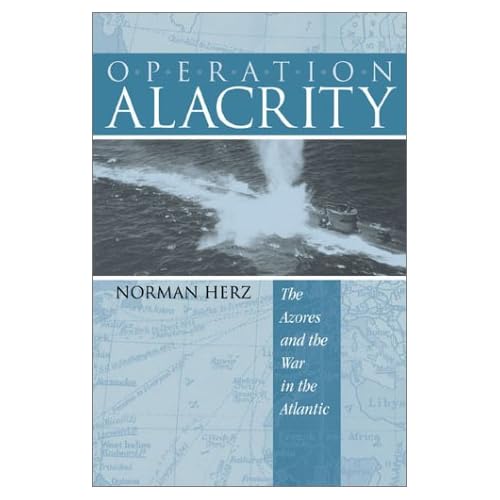
The book is “OPERATION ALACRITY - The Azores and the War in the Atlantic” from Norman Herz. He arrived in the island as a corporal with the U.S. Army Corps of Engineers' 928th Engineer Aviation Regiment, and latter wrote this book about the events and the importance of the island for the war effort.

There is also a site dedicated to the 801st Engineer Aviation Battalion in Word War II, that arrived in January 1944 in the Azores. It was made by the son of Robert Hawks, one of the soldiers that was part this battalion.

This is the Link: http://www.skydozer.com/index.html

 Besides that I would also leave the official site of the base in our days…

http://www.lajes.af.mil/index.asp

Best regards to all...